
The Domino Effect: Why Losing One Pub Cost Me Three
If you have spent any time in this industry, you will know that expansion is often presented as the ultimate benchmark of success. We are told that moving from one site to two, and then to three, is the natural evolution of a talented operator. It is the moment you transition from being a publican or a restaurateur into being a "brand". However, there is a quieter, more technical reality behind the glamour of growth that many only discover when things begin to unravel.
I learned this lesson through the collapse of a small group that I had spent seven years building. At the height of my operations, I was running three distinct venues: The Sun Inn in Bethnal Green; the Half Moon in Cuxham, Oxfordshire; and the Dew Drop Inn, a destination pub nestled in the Berkshire forest between Henley and Marlow. On paper, it was a triumph of diversification and scale. In reality, it was a house of cards waiting for the wind to change.
The Rhythm of the Circuit
Maintaining three sites across three different counties required a specific kind of madness. My weekly routine became a choreographed circuit of high-stakes shifts and long drives. Friday nights were reserved for the pass at The Sun Inn, a high-volume London site that required a relentless, driving energy. Saturday mornings involved a journey to Oxfordshire to manage the early dinner service at the Half Moon; they ate early in Cuxham, a rhythm I eventually learned to embrace rather than resist.
By late Saturday night, I would be back in the London office before heading to Berkshire on Sunday morning to work the kitchen for the roast service at the Dew Drop.
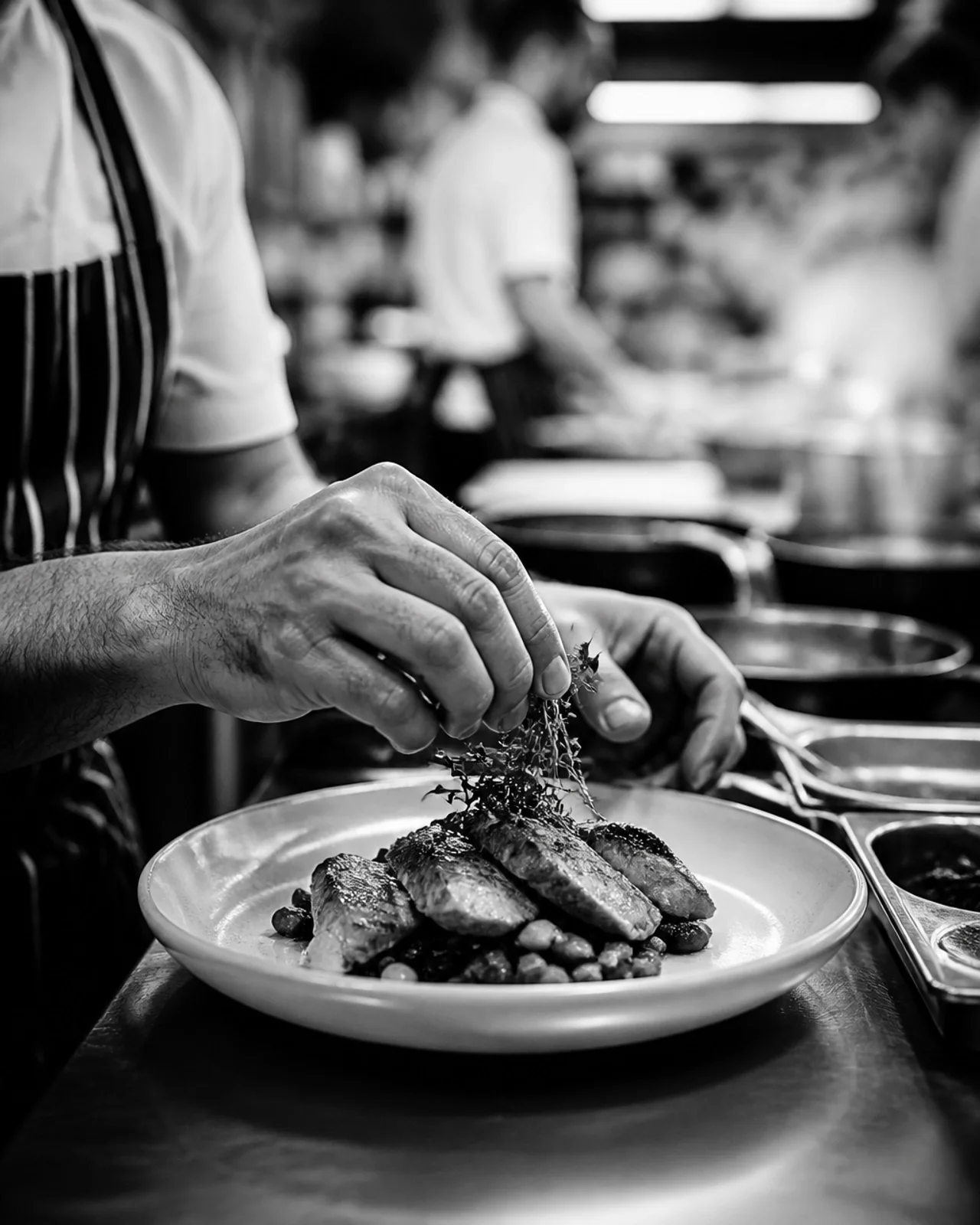
I had management in place at every site, of course, but my presence was the quality control mechanism. It was not about being everywhere at once; it was about being in the right place at the moment that mattered most for each specific venue. It worked, until the day it didn't.
The Hidden Financial Engine
To understand why the entire group failed, you must first understand the role of The Sun Inn. While the Half Moon offered fine dining and the Dew Drop provided a destination for game and foraged ingredients, The Sun Inn was the financial engine that powered the entire operation.
At its peak, The Sun Inn was generating nearly a million pounds in annual turnover. This volume did more than just pay the rent in Bethnal Green; it granted me a level of leverage with suppliers that a single-site operator can only dream of. Because of the volume of stock we moved through the London site, I was able to negotiate exceptional terms for the entire group.
The buying power of the "cash cow" was effectively subsidising the economics of the other two venues. The Half Moon, with its high labour costs and limited covers, operated on the razor-thin margins typical of fine dining. It was a beautiful, prestigious project that added weight to the brand, but it was the last thing that would have worked if it had been forced to stand alone.
I knew this in a vague, academic sense. I saw the group as a system of balance, where the strengths of one offset the vulnerabilities of the others. What I failed to recognise was that I had built a structure with only one truly load-bearing wall.
The Moment the Dominoes Fell
In late 2013, a lease clause I had signed years earlier caught up with me. The Sun Inn was sold to a developer, and the terms offered for a new lease made continued trading impossible. I was forced to walk away from a business generating £800,000 a year, not because of a lack of customers or a failure of service, but because of a legal technicality I had failed to fully appreciate at twenty-six.
The immediate loss was the turnover. The subsequent loss was the leverage.
Almost the moment The Sun Inn closed, the supplier terms that had kept the Half Moon and the Dew Drop viable were retracted. Suppliers who were happy to extend credit to a million-pound business became significantly more cautious when that business was suddenly doing a fraction of the volume. My credit terms vanished; my pricing increased; and the balance sheet for the remaining sites, which had been calibrated for a much larger operation, began to buckle.
I gave notice on the Half Moon almost immediately. It was a painful decision, as the team was exceptional and the reputation was stellar, but the maths was undeniable. Fine dining without the support of a high-volume engine is a fast way to lose a lot of money.
The Dew Drop Inn was the one I tried to save. It had a loyal local base and a strong weekend trade, and I believed it could sustain itself. However, the structural dependency I had built into the group was too deep. The debt and the loss of credit were too much for one destination pub to carry on its own. Within a short period, I had lost everything.
Identifying the Load-Bearing Elements
The lesson I take from this experience is not just about reading your lease properly, although that remains vital advice. The deeper lesson is about understanding the "load-bearing elements" of your business.
Most operators view their group as a collection of individual P&Ls. This is excellent for daily management, but it is dangerously incomplete for long-term strategy. A multi-site business is a system, and every system has parts that are doing more than their fair share of the work.
In my case, the London site was that element. It provided the cash flow, the supplier leverage, and the creditworthiness that allowed the others to exist. When that site was removed, the entire architecture collapsed because the other parts had not been built to be independent.
If you are currently operating multiple sites, or if you are planning to expand, you must ask yourself one question: Which site, if it failed tomorrow, would take the others with it?
If the answer is your flagship site, you have a structural risk that is currently being masked by your success.
How to Expand with Honesty
Expansion should be an evolution, not a desperate reach for scale. I often work with clients through our Plan and Grow packages to stress-test their models before they sign a second or third lease. We look for the "hidden dependencies" that I missed in 2013.
To build a resilient group, you must ensure that each site can, in a worst-case scenario, sustain itself. This means:
Independent Supplier Terms: Avoid models where your pricing at Site B is entirely dependent on the volume at Site A.
Cash Reserves: Ensure you have enough liquidity to survive the loss of your highest-performing engine for at least six months.
Operational Autonomy: Build systems that do not rely on a single owner or a single manager covering three counties in three days.
Stress-Testing: Literally run the numbers on what happens to your overall profit if your best site disappears.
If the thought of losing your best site makes the entire plan look impossible, then the plan is not yet ready. It is better to have a smaller, more robust business than a larger, fragile one.
A Final Note on Architecture
Hospitality is a romantic industry. We talk about the "feeling" of a room, the "soul" of a menu, and the "connection" with a guest. These things are essential; they are why we do what we do. But they are the decoration on the building, not the foundation.
I lost three pubs because I focused on the circuit and the service while ignoring the architecture. I built a system that was efficient, but not resilient.
Today, when I help operators open new venues, my focus is always on the structure first. We ensure the leases are sound, the margins are independent, and the growth is honest. We build businesses that can withstand a blow, because in this industry, the blows will eventually come.
Build the architecture first. The rest is just service.
Benjamin Sawyer is the Founder of Atelier Sawyer, a hospitality consultancy providing hands-on support for independent operators. Whether you are navigating a difficult turnaround or planning your first expansion, we provide the practical experience you need to succeed.
If you want to discuss the structural health of your business, you can book a consultation here or contact us at enquiries@ateliersawyer.com.